

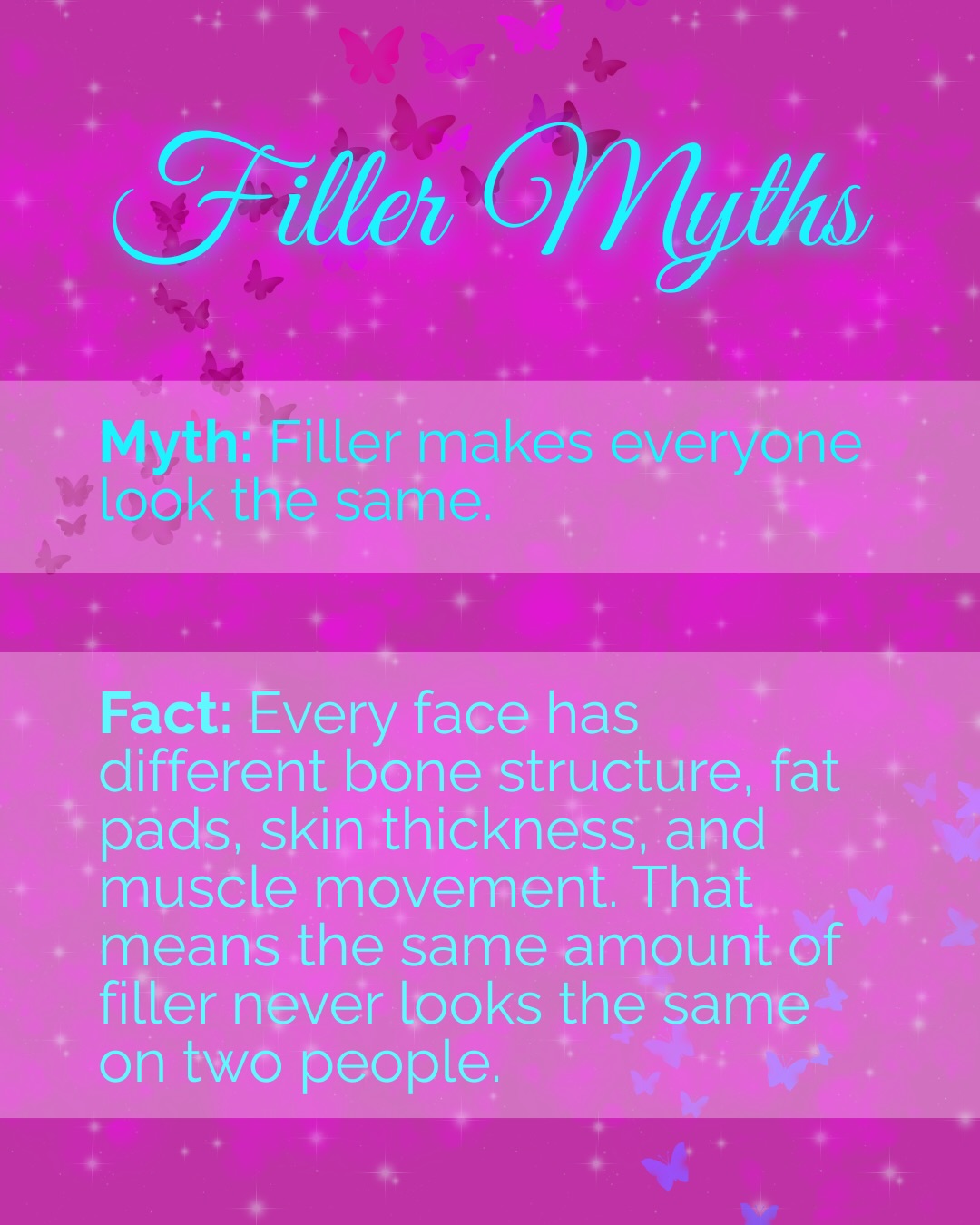
No. Filler doesn’t make everyone look the same — overfilling does. Your bone structure, your fat pads, your skin, and the way your face moves all decide how a syringe settles on you. Plan around that anatomy and you look like you. Ignore it and you start to look like everyone else who ignored it.
I posted a Filler Myths card about this on Instagram in July, because “I don’t want to look like that” — usually with a screenshot of someone’s overdone cheeks — is one of the most common things I hear in my Chandler treatment room. It’s a fair worry. It’s also the easiest one to answer, because the fix isn’t a different product. It’s a different plan. (The other first-timer worry — the needle — gets its own post: does filler hurt?.)
Why the same syringe never looks the same twice
Here’s how I put it on the post, and I stand by every word: Your bone structure, where your fat pads sit, how thick your skin is, and how your muscles move all decide how filler settles and moves on you specifically. That’s why the right amount and placement on one person can look completely wrong on another.
Two of those four are worth unpacking, because the research on them is genuinely striking.
Bone. Your facial skeleton is the scaffolding everything else rests on, and the soft tissue over it doesn’t age evenly. CT studies of facial soft-tissue thickness show the changes vary by landmark — thickening at some points, like the brow and the rim of the eye socket, and thinning at others, like the chin and the mid-philtrum (the groove above your upper lip) — and they differ between men and women. Two people the same age can have very different support at the exact spots where I’d place filler.
Fat pads. The fat in your face isn’t one layer. It’s organized into distinct compartments, superficial and deep, and they don’t respond to filler equally. In a cadaveric volumetric study, identical 0.1-cc drops of filler produced markedly different surface changes depending on which compartment received them: the fat just beneath the eye muscle showed the biggest surface change, the deep medial cheek fat the smallest. Same product, same amount, same technique — a different visible result, purely because of where it landed and whose face it was in.
Skin thickness and muscle movement are the other two variables on that card. They’re why I watch your face move before I draw anything up, and why two patients with near-identical cheekbones can still walk out with different products in them.
Where the “everyone looks the same” look comes from
Overfilling. Not filler — overfilling: more volume than the bone and tissue underneath can carry, or volume placed by a formula (“two syringes of cheeks, one of lips”) instead of by the face in front of the injector. The result is the look you’ve been screenshotting: cheeks that sit too high or too far forward, lips that are big relative to everything else, a smoothed-over face that doesn’t quite move.
This isn’t just an Instagram complaint, either. The clinical literature now has a name for it — facial overfilled syndrome — an increasingly recognized complication of injectable treatments, marked by excess facial volume and contour irregularities that distort natural anatomy and movement.
Here’s my take from the post: Overfilling doesn’t account for any of that. It treats every face the same — which is why overfilled faces tend to end up looking eerily similar to each other: same cheeks, same lips, same flat expression, regardless of what that person’s actual anatomy called for.
The syringe didn’t do that. The plan did.
The product is a choice, too
Juvéderm and Restylane aren’t one product each — they’re families, and each member is built for a job. On the Juvéderm side, Voluma adds structure to the mid-face and cheeks, Volbella gives lips soft volume and smooths vertical lip lines, Vollure softens smile lines, and Volux sharpens the jawline. On the Restylane side, Lyft is structure, Kysse is lips, Defyne handles deep folds while keeping natural movement, and Refyne handles finer lines with flexibility. I carry both full lines in-house for one reason, and I’ve said it before: I carry the full Juvéderm line so I can match the product to the anatomy, not the other way around.
Using one gel everywhere is the second way faces end up looking alike. Choosing the product for the area — and, yes, sometimes layering two — is part of how a result stays proportionate to the face it’s on. (And if what you’re really describing is overall deflation rather than one spot that needs structure, the answer may not be a hyaluronic-acid filler at all — read my note on Sculptra vs traditional filler.)
How I plan filler in my chair
The plan starts with your face in motion, not a menu. Smile, talk, turn — I’m watching where volume actually sits, where it’s gone, and what moves. Then the product gets matched to the area, and the amount gets set by your anatomy, not by a standard number of syringes. Conservative and individualized is how I’ve always worked — less is sometimes more — and “facial balance” isn’t a slogan here, it’s the actual decision rule.
Bigger changes are built, not bought in one afternoon. A syringe now, let it integrate, reassess, layer the next — my lip filler post walks through exactly why. And how long a result holds depends on the product and the area: our Juvéderm page lists 8 months to 2 years, our Restylane page 8 to 16 months.
That’s the standard whether you’re walking in from Ocotillo, from elsewhere in South Chandler, or from across Chandler — the Flawless Faces medspa in Chandler is on Alma School Rd, and the plan is yours either way.
Your questions, answered
Will filler make me look like everyone else?
Not if it is planned around your anatomy. The research shows the same amount of the same product produces a different visible result depending on which fat compartment it lands in and how much soft-tissue support sits at that exact spot — which is why I never place filler by a formula. What makes people look alike is overfilling: volume beyond what a face can carry, placed the same way on everyone. The goal in my chair is a face that looks rested and proportionate, and still unmistakably yours. Individual results vary.
How do you decide how much filler I need?
From your face, not from a chart. I watch your face move, look at where volume actually sits versus where it has gone, match a product to each area, and set the amount by your anatomy rather than by a standard number of syringes. First visits are usually conservative on purpose — it is easy to layer more at a follow-up, and larger changes hold up better when they are built across visits than when they are done in one afternoon.
Can filler be dissolved if I do not like it?
Yes. Juvéderm and Restylane are hyaluronic-acid gels, and hyaluronic acid can be broken down with an enzyme called hyaluronidase when a result needs to be reduced or corrected — enzymatic treatment is also how the clinical literature describes managing an overfilled face. We keep hyaluronidase on hand. It is a real safety net, but it is not a plan: the better version is a conservative first visit so we never need it.
The bottom line
Filler doesn’t make everyone look the same. Ignoring anatomy does. Your bone, your fat pads, your skin, and the way you move set the plan — and when the plan comes from your face, the result looks like you on a very good day. Pretty face, pretty aura, as the card says.
Bring the screenshots — the ones you love and the ones you’re scared of; both are useful. Book a consult and we’ll map what filler on your face looks like, before anyone draws anything up.